Dr. Margaret Swift
  • home
  • about
  • cv & publications
  • research =
    • public talks
    • introduction to african savannas
    • ✭ simulating african elephant movements on a fenced landscape ✭
    • mapping waterholes in africa's largest conservation area
    • antelope behaviors on a changing landscape
  • outreach =
    • lesson plans & tutorials
    • teaching statement
    • nsf grfp advice
    • science writing
    • skype a scientist
  • perspectives =
    • those who made me
    • where i live & work
    • decolonization
    • land-grab universities
    • going beyond land acknowledgement
    • asexuality, imposter syndrome, and belonging
    • reading lists
  • art =
    • support small artists [NEW!]
    • short stories
    • poetry
    • photography
    • portraits
  • blog
Me, the woods, Massachusetts
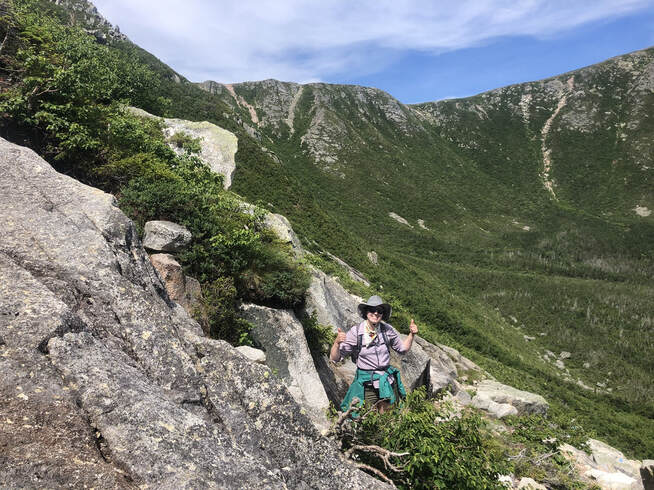
Mount Katahdin, Maine, USA, 2021. My friends and I hiked Mount Katahdin last summer, one of the tallest mountains on the east coast of the US! I was very tired and hungry during this picture, and my feet hurt a lot, but it was worth it for a beautiful view and spending time with my friends.

Welcome to my Skype a Scientist page!


​Hi! My name is Maggie, and I'm a researcher at Cornell University, located in beautiful Ithaca, New York. Ecology is the study of how the plants, animals, microbes, humans, and fungi around us work together with rocks, air, fire, water, sunshine, and soils to create the world we live in. For my research, I use computers and satellites to study the ecology of southern African savannas (ecosystems with trees and grasses mixed together).

Elephant, zebra, buffalo, and other big mammals get thirsty and hungry just like we do, and they often have to travel a long way to reach water and food. This is much more complicated than carrying a water bottle and a snack, and we can't just ask an elephant! So, I try to figure out why animals go where they do using science.

Some things about me: 
  • I grew up in the small town of Warrenton, Virginia.
  • When I was a kid, I played in the woods every day.
  • I have a tabby cat, named Izzy.
  • My hobbies include hiking, guitar, sewing, baking, and reading books.

​To get you started, you can ask me:
  • Where have you traveled for your field work?
  • Have you ever been scared when working?
  • What were you like when you were my age?
  • What was your favorite subject in school?​
Me, the woods, Massachusetts
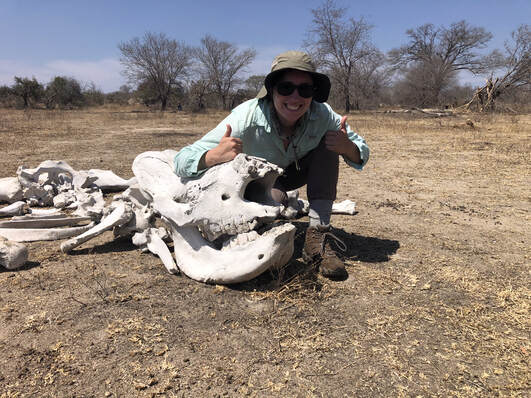
Kruger National Park, South Africa, 2021. My field class put together this rhinoceros skeleton from bones that we found scattered around the savanna. You will notice this rhino does not have a horn---this is probably because rangers cut it off at some point so that poachers wouldn't steal it.

For educators

I sometimes get asked about poaching, and this can be a sensitive subject for many students. The London-based organization Tale 2 Tail (www.tale2tail.org) has some amazing resources for teaching kids about the illegal wildlife trade. I especially like this one: Animal Ambassadors: Activities for 5–12 year-olds exploring the illegal wildlife trade.


Where have I skyped?

I've been working with Skype a Scientist for many years now. Check out the map below to find out where I've had video calls -- your school could be next! The red house is my home, in Ithaca NY, USA. I grew up in Virginia (red heart) and study in Kruger National Park (red rhino) and the Okavango Delta (red elephant)
Home
About
Contact
​Margaret Swift
Atkinson Postdoctoral Fellow
Cornell K. Lisa Yang Center for Wildlife Health
Cornell University
​Ithaca, New York, USA
  • home
  • about
  • cv & publications
  • research =
    • public talks
    • introduction to african savannas
    • ✭ simulating african elephant movements on a fenced landscape ✭
    • mapping waterholes in africa's largest conservation area
    • antelope behaviors on a changing landscape
  • outreach =
    • lesson plans & tutorials
    • teaching statement
    • nsf grfp advice
    • science writing
    • skype a scientist
  • perspectives =
    • those who made me
    • where i live & work
    • decolonization
    • land-grab universities
    • going beyond land acknowledgement
    • asexuality, imposter syndrome, and belonging
    • reading lists
  • art =
    • support small artists [NEW!]
    • short stories
    • poetry
    • photography
    • portraits
  • blog